PRESENTED BY AI TOOL REPORT
There’s a reason 400,000 professionals read this daily.
Join The AI Report, trusted by 400,000+ professionals at Google, Microsoft, and OpenAI. Get daily insights, tools, and strategies to master practical AI skills that drive results.
Have you ever heard of Zoho company, an Indian multinational technology company that specializes in software development, particularly in the area of web-based business tools?
Yes, the guy behind it is Sridhar. His company Zoho:
Crossed $1B in revenue
Teaches students for free and later hires them
Employs 12K+ people worldwide
But the amazing thing is, he runs his whole company from a rural area in India. Which is genius, let’s dive into this amazing founder story.
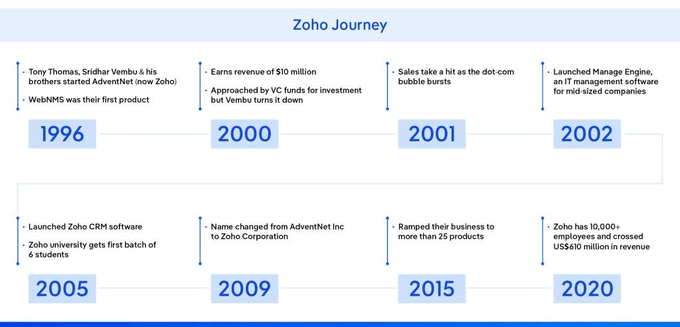
Image source
Table of Contents
How this all started
Sridhar Vembu was born in a Southern village in India.
He was born into a middle-class family but it didn’t stop him from chasing his dreams. Sridhar completed his Ph.D. from Princeton University in 1994 and joined Qualcomm as a wireless engineer.
Sridhar image with his peers
Life was going pretty well.
But Sridhar wanted to do something amazing and fruitful for the community he grew up in.
He would meet his brother every weekend and discuss returning home and building a tech company, as this was the beginning era for many of today’s tech giants. So, he was looking to build something, similar in India.
And the day finally came in 1996.
Sridhar’s brother left his well-paying job to start a network management company AdventNet in his hometown.
Everything started pretty well, but his brother realized the team, which was building a good tech business was failing at sales.
Sridhar was still in his job at this point. So, his brother made him agree to join them too, to minimize the shortcoming.
So, this led Sridhar to become the first salesperson of AdventNet even though he was terrible at it and he even designed their logo on Microsoft Paint!
Screenshot of his Twitter post
To promote Advent Net, he printed a bunch of business cards and reached the Las Vegas trade show.
As an engineer, Sridhar could explain the product very well.
But he couldn’t become a good salesman. Many clients even told him that they would pay him 10X more for the same product. But this stagnant phase of their company didn’t last for long. Because …
Image Source
AdventNet company crossed $350K+ in sales, by the end of 1997.
They adopted a direct sales model and launched products like WebNMS and MailEnable which had pretty novice features.
They also began selling the software to internet companies in different countries such as China and Japan.
The other amazing thing they did is.
Instead of paying themselves, they reinvested every bit of revenue in the development of a new product named WebNMS. You will be even more surprised to know that the team took their first salary when their sales reached $1M (in 1998).
Company logo
The beginning of the dot-com bubble
In 2000, AdventNet crossed $10M in revenue, and at the same time, Sridhar and his brother got a huge investment offer.
But he turned it down.
The reason behind this was, that he didn’t want to be under investor pressure and launch mediocre products for customers.
But regret that later, as he wished he had taken it because.
Screenshot of graph, dot-com bubble (2000)
The dot-com bubble burst in 2000 and took away most of their clients.
Also, their main product, WebNMS had reached market saturation. So they had to focus on building a new product.
AdventNet was losing money every single month.
Because of many things happening at the same time, everyone at the top management had a different idea of how to move forward with the company.
So in the end, they had to part ways. But Sridhar didn’t leave the company.
According to him, that was the most depressing period of his life. He and his employees worked hard on pivoting the company to a different direction.
That’s when their new product Manage Engine was born.
With Manage Engine the aim was to help companies manage all major IT operations. Manage Engine was so great that almost 60% of companies using it were Fortune 500 companies.
Screenshot of Wiki
The birth of Zoho
In 2005, Sridhar and his team expanded again with a new division, Zoho. The first product was Zoho Writer, an online word processor. In 2006, Google bought Writely and launched Google Docs.
They knew the competition with Google would be tough, so they created a new product — Zoho CRM. Zoho CRM was a huge success.
Only 2 years later (2008), and after reading 1M+ users and almost 1K employees, they officially rebranded as Zoho. But there was another problem — the lack of software developers in India was hindering the company’s expansion rate.
So Sridhar and his team decided to take this challenging problem head-on.
They started by providing free quality education (under Zoho Schools). They take this step to the next level by paying students a monthly stipend over the entire course. Today this is almost 90% of their talent/hiring strategy.
This is crazy and it works so well.
This whole schooling step not only saved their company but also helped thousands of Indians get better jobs in the tech industry.
Not to hand over another degree but to teach the actual things required to succeed on the job.
Image source
How Zoho is doing today
Today, Zoho has ramped up its business to 55+ products. They are more than just a traditional company having more than 12000+ employees and are serving 100M+ users worldwide.
Image of Zoho growth index
But the most coolest and craziest part is that Sridhar operates this billion-dollar empire from a village.
Today, Zoho has many offices in various villages in India. Sridhar firmly believes it’s important for employees to have an affordable lifestyle.
This move of his also helped boost local economic growth.
Image Source
Founder story lesson
No doubt, Sridhar’s willingness to pivot has helped the company a lot. But he has also proven that talent is easy to build.
And you don’t need to operate from expensive cities to build a huge company.
Enjoy the newsletter? Please forward this to a pal. It only takes 18 seconds. Making this one took me 12 hours.
New around here? Join the Newsletter (It’s free).
